





Most deposit plans include a growth number, but far fewer include the number of checking accounts it will take to get there. Instead, the acquisition goal is usually set on its own, often as a percentage increase over last year’s openings. That approach is familiar and easy to track. It also explains how an institution can meet its acquisition goal and still fall short on deposits.
The fix is to build the acquisition target from the deposit goal itself. The math takes four steps, and most institutions already have the inputs. To make it concrete, we’ll follow one example institution through all four steps.
The figures are illustrative and simplified. Your own numbers will differ, which is exactly why the exercise is worth doing.
Our example institution:
- About $750 million in assets
- 7,000 checking accounts
- $90 million in checking balances
- Goal: 5% checking deposit growth
Step 1: Start with the Deposit Goal
Begin with the share of deposit growth the plan expects checking to deliver. In our example, 5% growth on $90 million is $4.5 million in new checking balances.
This is the number finance already cares about, because it connects to liquidity, funding costs and lending capacity. Starting here keeps everything that follows tied to the strategic plan instead of last year’s production report.
Step 2: Translate Dollars into Funded Relationships
Next, estimate what a new funded relationship typically holds after its first year. The key word is new. The average balance across the whole portfolio includes long-tenured relationships that have had years to grow, so it tends to overstate what a first-year account will carry.
If new funded relationships average $6,000 after year one, the institution needs 750 of them to reach $4.5 million.
Step 3: Account for Accounts that Never Get Funded
Not every opened account becomes a funded, primary relationship. Some are opened for a promotion, some are secondary accounts, and some simply never get going.
If 60% of new accounts become funded and active, reaching 750 funded relationships requires 1,250 net-new accounts. If you don’t know your institution’s rate, the first 90 days are the place to start measuring.
Step 4: Add Back What Attrition Takes
Every year, some accounts close. Account holders move, switch institutions or stop using the account. Those losses have to be replaced before any new account counts as growth.
At 12% annual attrition, our example institution loses 840 checking accounts a year. Added to the 1,250 net-new accounts from Step 3, the plan requires 2,090 openings.
Working backward from the deposit goal
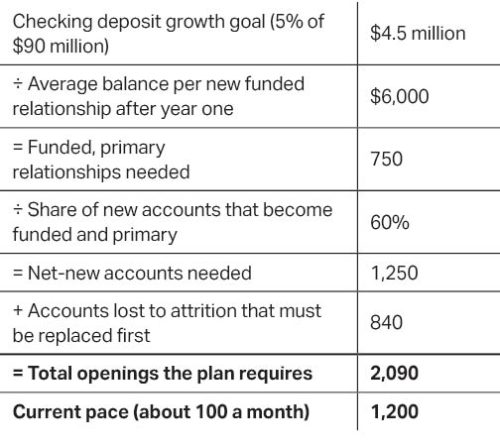
Broken down by month, that’s roughly 175 openings. An institution opening about 100 per month, or 1,200 per year, would finish roughly 900 accounts short even with strong campaigns all year. The shortfall was built into a target that was never connected to the deposit goal.
Where the Math Usually Breaks
The steps are simple, but it’s the assumptions behind them that are where most plans drift. Four come up often.
Attrition is left out. Closed accounts are typically reported somewhere other than new accounts, so they rarely get subtracted from production. In our example, leaving it out would set the target at 1,250 openings, close to the current pace of 1,200, when the plan actually needs 2,090.
Every new account is treated as funded. Counting openings as relationships skips Step 3 entirely and can understate the target by hundreds of accounts.
The portfolio average stands in for new-account balances. Using our example’s portfolio average of about $12,900 instead of $6,000 lowers the target to about 1,400 openings. That’s close enough to the current pace to suggest the plan is nearly on track, when it’s actually about 700 accounts short.
Replacements are assumed to be equal to what was lost. A closed account may have carried years of balance growth. The new account that replaces it usually starts much smaller, so replacing the count doesn’t always replace the dollars.
More Than One Way to Close the Gap
Once the target is built this way, it also shows where to act. Volume is only one lever.
In our example, raising the share of funded new accounts from 60% to 75% lowers the net-new requirement from 1,250 accounts to 1,000. Reducing attrition from 12% to 10% means 140 fewer accounts to replace. Together, those two changes would shrink the 900-account gap to about 500 before a single additional campaign launches.
That’s what makes the number useful. It gives acquisition, retail and finance one target, expressed in financial terms, with a clear view of which levers will move it the most.
See What Your Numbers Say
Our deposit growth calculator starts with three numbers you likely already have: checking accounts opened each month, checking accounts closed each month and your deposit growth goal. After your numbers are entered, the ADVANTAGE team will walk you through a personalized growth report showing how many funded relationships your goal requires and where the biggest opportunities are to close the gap.
ADVANTAGE partners with community banks and credit unions to acquire new checking relationships, deepen account holder engagement, strengthen non-interest income and reduce operating costs. With more than four decades of industry experience, ADVANTAGE helps financial institutions connect these priorities through data-driven solutions and hands-on expertise.