





For years, federal solar tax incentives were largely the domain of multinational banks and Fortune 500 corporations. Utility-scale projects, measured in hundreds of megawatts, required balance sheets and tax appetites that placed them beyond the reach of most community institutions. That paradigm is changing. Today, distributed residential solar — aggregated across thousands of homes and financed through standardized structures — has opened the door for community banks to participate in investment tax credits (ITCs) and accelerated depreciation in a way that is scalable, repeatable and well aligned with community banking models.
A Shift from Mega-Projects to Distributed Assets
Federal energy policy has reshaped the economics of renewable energy ownership. The Inflation Reduction Act of 2022 expanded and extended the solar ITC, increased credit amounts for qualifying projects, and reaffirmed accelerated depreciation as a core incentive for taxable owners. The policy was a major driver of residential solar growth. Solar energy accounted for 66% of new U.S. electricity-generating capacity in 2024 and 54% in 2025, according to data from the Solar Energy Industries Association (SEIA).
However, more recent legislation under the One Big Beautiful Bill Act (2025), which eliminated most of the residential solar tax credit for direct homeowner purchase, is altering the ownership landscape of residential systems. Under the Act, third-party owned (TPO) residential systems continue to qualify for ITCs. Since consumer demand for lower, more predictable energy costs hasn’t diminished with the tax credit, solar investors are turning to TPO structures. The structure allows a third-party with tax capacity to step in as owner while still providing consumers with energy savings through long-term power purchase agreements (PPAs) or leases. This shift in who actually owns the solar assets creates an investment opportunity for smaller community banks to participate in tax advantaged solar deals and secure a stable return backed by the U.S. government. Rather than financing one massive facility, banks can now invest in diversified portfolios of residential systems — each small on its own, but collectively capable of supporting meaningful tax benefits and cash yields.
Strategic Partnerships Help Banks Navigate Complexities
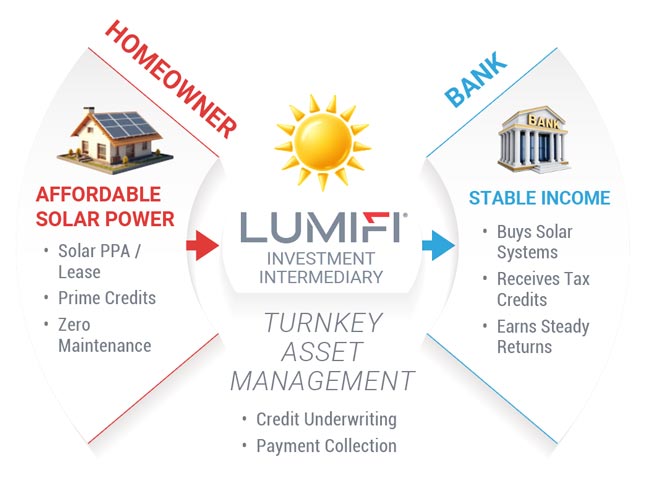
For many community banks, solar tax credit investments can feel operationally daunting. There are regulatory, accounting and tax nuances that often reside outside the familiar territory of a loan structure. Additionally, building in-house expertise to source and manage a portfolio of solar assets is a formidable task. Instead, community banks are partnering with solar financial firms that already have the resources and expertise to capitalize on residential solar opportunities. Reputable solar investment firms can be the bridge between the bank and the consumer, packaging a portfolio of solar assets to meet the bank’s needs, while handling everything from deal origination, qualifying and underwriting eligible homeowners, collecting payments, claiming tax credits and servicing the assets. Banks step in as owners, capture tax benefits and generate returns from day one — without building new capabilities. A savvy partner well-versed in the nuances of the residential solar market creates a turnkey, low-risk pathway to clean energy markets for banks.
How the Model Works
A solar investment partner, such as Lumifi, develops and originates residential solar systems nationwide, offering homeowners long-term PPAs and leases. Entry into these contracts is limited to borrowers who meet strict credit underwriting standards, emphasizing stability and long-term perfhormance. Once systems are installed and operational, Lumifi sells them to banks under a sale-leaseback structure. The bank becomes the tax owner of the solar assets, and leases them back to Lumifi, who essentially stands in for the consumer, under a long-term master lease.
As tax owner, the bank receives:
- 30-50% federal investment tax credits, depending on project qualification
- 100% bonus depreciation, recognized in the first year
- Contracted lease payments that provide ongoing cash yield
- Favorable GAAP accounting earnings
For many banks, tax benefits represent a significant portion — often the majority — of total investment return, with the remainder coming from predictable lease payments.
Why This Fits Community Banks
Unlike traditional tax credit investments such as LIHTCs or NMTCs, solar tax benefits are realized quickly, and GAAP earnings are always positive. Both the ITC and bonus depreciation are available once the system is placed in service, allowing banks to align tax planning with near-term earnings and capital management objectives. Residential solar portfolios also offer:
- Diversification away from traditional loan products
- Granular risk exposure across thousands of end users
- Asset lives measured in decades, with contracted revenue streams
Importantly, these structures are designed to fit within existing regulatory frameworks. Solar ownership has long been recognized as a permissible activity for national banks under OCC guidance and rulemaking, and similar authority exists for state-chartered institutions when properly structured.
Underwriting Matters
Not all solar assets carry the same risk profile. Successful participation requires diligence across multiple layers:
- Counterparty strength and servicing capability
- Portfolio-level performance and degradation assumptions
- Contract enforceability and system warranties
- Structural protections within the lease framework
By partnering with an entity with a proven structure in place focused exclusively on residential solar with institutional standards, banks can access assets that have already been underwritten, aggregated and standardized for financial ownership.
Beyond Returns: Community Impact
For many community banks, investing in residential solar aligns naturally with broader community development and sustainability goals. Financing energy infrastructure for owner-occupied homes reduces household energy costs, supports grid resilience and contributes to emissions reduction — benefits that can be measured and reported alongside financial performance.
As distributed energy continues to scale, community banks are no longer spectators. With the right structure and partner, solar ownership has become an accessible, tax-efficient asset class that fits squarely within community banking’s risk discipline and mission.
Lumifi is a national energy infrastructure company that partners with institutional investors to expand access to residential solar through long-term power purchase agreements and leases with prime-rated homeowners. Utilizing a sale-leaseback structure, Lumifi enables banks and credit unions to acquire high-quality distributed solar assets and benefit from federal incentives — providing investment tax credits and bonus depreciation to taxable owners and direct pay ITCs to tax-exempt institutions — while Lumifi retains operational responsibility under a long-term master lease. With a focus on rigorous underwriting, standardized contract terms and scalable portfolio development, Lumifi delivers reliable cash flow, measurable community impact and a disciplined path to renewable energy ownership.